

In this article, we will learn everything about click-through rates, how to calculate them, factors affecting CTRs, and how they can impact your digital marketing strategies.
Table of Contents
What is Click-Through Rate (CTR)?
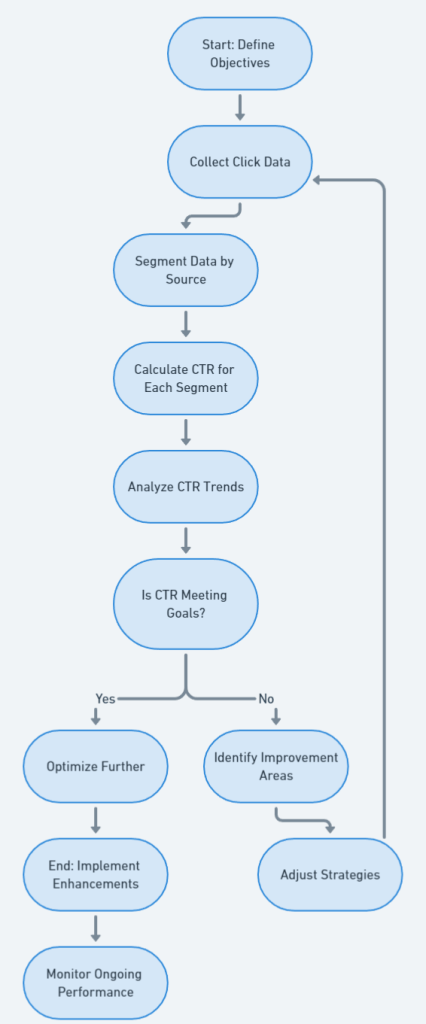
Click-through rate (CTR) measures how often people click on an ad, link, web page, or email. It is calculated by dividing the number of clicks by the number of impressions(the total times the ad or link was displayed on a screen).
The click-through rate indicates if your content was effective in engaging and attracting attention across various formats, whether it’s an ad, link, web page, or email.
A high CTR suggests the content is compelling and relevant to viewers. A low CTR might indicate that the content needs to be enhanced to better capture the interest of the audience.
| Note: A high click-through rate (CTR) isn’t always a sign of success. It can be misleading if it results from irrelevant or misleading content. And that can further lead to clicks without quality leads or conversions. For example, targeting irrelevant keywords can waste ad spend and decrease return on investment. A high CTR does not necessarily mean better engagement or more revenue in such cases. Thus, always ensure that clicks come from genuinely interested users, which makes the high CTR meaningful and beneficial for the marketing campaign. |
Click through rate formula
The basic formula for calculating CTR is:

This formula determines the percentage of people who clicked on a specific link or ad compared to the total number of people who viewed the page, email, blog, or ad.
By dividing the total number of clicks by the total number of impressions, you can calculate the CTR.
For example, if a link receives 50 clicks and has 1,000 impressions, the CTR would be 5.0%:

What Can Be Considered a Good CTR?
When it comes to determining what a “good” click-through rate (CTR) is, one has to consider several factors. These include:
- Industry Standards
- Keyword Relevance
- Type of Ad Campaign
- User Experience
And the list goes on.
Good CTRs differ across platforms and industries. For example:
- Ecommerce industry (in Google Ads): For Search, the CTR comes around 2.5%, whereas for the Google Display Network (GDN), the CTR is around 0.51%.
- Branded Links: These have a higher CTR compared to generic short links, with an increase of up to 39% in click-through rates.
- Email Marketing: Good CTRs range from 10% to 20%, with highly targeted emails possibly achieving higher rates.
So, it’s hard to define a universally “good” CTR without considering specific contexts. Each industry and platform varies, affecting what is deemed a successful rate.
Bonus: You can have a look at the industry-wise average click-through rates here.
Factors Influencing Click-Through Rate (CTR)

Several factors affect the click-through rate (CTR) of links. These include:
- Content Relevance: Content must match the audience’s search intent. For example, using SEO to target specific keywords related to “organic gardening” boosts CTR for those interested in eco-friendly farming.
- Visual Appeal: Eye-catching images or graphics also play an important role in deciding whether a user clicks on your blog page, website, ad, etc., or not. Thus, make the most of the visual elements and make them attractive and relevant to your content so that users click on your link.
- Platform Used: The digital platform where your content, links, or ads are displayed (like social media vs. a search engine) impacts CTR. Why so? It’s because user behavior varies across different platforms.
- Audience Targeting: Understanding the target audience and creating personalized content that speaks to their interests can also help boost click-through rates.
- Reputation and Trustworthiness: If the brand or website has a good reputation, users are likelier to click on its website pages, emails, ads, or links.
Pro tip💡: Showing positive reviews can significantly boost CTR. Content with high reviews generally receives more engagement than those with fewer or no reviews.
- Call to Action (CTA): A clear and compelling CTA is important. It guides users on what to do next, like “Shop Now” or “Learn More,” which can increase the click-through rate.
- Mobile Optimization: Nowadays, with a major portion of web traffic coming from mobile devices, it’s important to ensure that your web pages, blogs, etc., are optimized for mobile use to maintain a high CTR.
- Timing and Frequency: Click-through rates improve when you time your emails, ads, or content to match when your audience is most active. For example, retailers get better email responses in the evening, when shoppers are more likely to be online.
Average CTR Across Different Industries and Contexts
Let’s now learn how click-through rates vary across different contexts and platforms.
Organic Search Results
CTR statistics for organic search results include
- #1 organic search result: 39.8% CTR.
- #1 organic result receives 19x more clicks than the top paid search result.
- Top 3 organic search results receive over two-thirds (68.7%) of all clicks on Google Search page.
- Snippet (replacing #1 organic result): 42.9% CTR.
- Positions 8-10 have virtually the same CTR.
- Moving up 1 spot in search results increases CTR by 2.8% on average.
Email Click-Through Rates
The average email CTR across industries is around 2.6%, with government emails having the highest CTR at 6%.
Other sectors show varying performance, with Education and Healthcare Services demonstrating strong CTRs of 4.30% and 3.70%, respectively.
On the other hand, the retail industry, with a low click-through rate of 1.10%, highlights the challenge of capturing consumer attention in a highly competitive digital market.
Blog Post Click-Through Rates
Blog posts generally see average CTRs from 1-3%. Posts with titles that include search queries and actionable content can achieve CTRs of up to 19.6%, and those answering specific questions can reach up to 56.8%.
Successful CTRs depend on how titles and content align with what readers are searching for.
Tip 💡: Improve CTR for ‘how-to’ articles by crafting titles that are direct and informative, like “How to Enhance Your SEO in 3 Easy Steps.” Ensure the title precisely reflects the practical value and solutions your article offers, appealing directly to users’ specific search intents.
Average CTRs for Video Ads
For social media video advertising, platforms like YouTube have an average CTR for video ads ranging from 0.10% to 1%, while Facebook’s video CTR is around 1.78%.
Skippable linear video ads have a CTR of 1.50%, while interstitial skippable ads have engagement rates of 1.41%.
Click-Through Rates For Different Advertising Platforms
- Google Ads: On average, the click-through rate (CTR) for Google Ads is 1.91% on the search network and 0.35% on the display network across all industries.
- Bing ads: The average click-through rate (CTR) on Bing Ads across all industries is 2.94%, which is significantly higher if we compare Bing ads with Google ads and other platforms.
- Facebook Ads: Averages around 2.50%, with variation depending on the industry and type of ad campaign. Lead-generation ads tend to have higher CTRs.
- Instagram Ads: Generally lower, averaging around 0.58%. Instagram Stories can have higher rates, around 0.33% to 1%, influenced by engagement and creative content of the ads.
- Twitter Ads: The average CTR for Twitter ads across all industries is approximately 1.64%.
- TikTok Ads: The average CTR for TikTok ads is reported to be above 1%, with specific CTRs for different ad formats such as TopView ads (12-16%), Brand Takeover (7-10%), and In-feed ads (1.5% – 3%).
How to Improve Your Click-Through Rate
There are some tips and strategies that you can use to improve your click-through rate. These include:
- Use Power Words and Emotions in your Digital Content or Ads: Titles, subject lines, or content that evokes emotions tend to attract more clicks. Thus, use power words.
- Use Specific (long-tail) Keywords: Refine your keyword strategy by also using long-tail keywords that match specific user queries.
Stats say that longer keywords tend to have a higher CTR, with keywords between 10-15 words getting 1.76x more clicks than single-word terms.
For instance, as a merchant who wants to capitalize on e-commerce keywords, instead of using broad keywords like “women’s shoes,” use more specific phrases like “women’s running shoes for flat feet,” which are likely to attract more qualified clicks.
- Compelling CTAs Based on User Journey Stage: Tailor your CTAs based on the user journey stage. For new visitors, a CTA like “Learn More” can be less intimidating than “Buy Now.” For returning visitors or those at the decision stage, use more urgent CTAs like “Order Today to Save 20%!”
- Use of Psychological Triggers: Use elements of urgency, scarcity, or exclusivity in your content, emails, or ad copies.
For example, an email related to a sale could say, “Hurry, sale ends in 48 hours!” to encourage quick action from recipients.
- Focus on Improving Mobile Optimization: Go beyond basic mobile-friendly layouts by optimizing the load time and interactive elements of your mobile ads.
Test button sizes for easy tapping and ensure that the most important information appears on the screen without scrolling.
- Know Your Audience: It’s important to target the right audience. And for the same, you can develop buyer personas. Also, try segmenting your audience and personalize your messaging accordingly.
The Impact of CTR on Digital Marketing Success
Click-Through Rate (CTR) is a key performance indicator in digital marketing.
In PPC campaigns, a high CTR contributes to a better Quality Score, which is a metric Google uses to determine the relevance and quality of your ads. A better Quality Score can lead to improved Ad Rank, which is your ad’s position on the page.
The same applies to blogs and emails. For blogs, a high CTR means that your titles and content are engaging and relevant to your audience, encouraging more clicks and interactions.
In email marketing, a high CTR shows that your subject lines and email content are effective, leading recipients to take desired actions like clicking on links.
In all cases, improving your click-through rate (CTR) can make your digital marketing more cost-effective. When more people engage with your content, it often costs less per click. This means you can reach more people without spending more money, as platforms tend to reward content that gets more clicks with lower costs and better visibility.
Conclusion
We hope this guide has made understanding Click-Through Rate (CTR) easier. Remember, a good CTR means that your digital content—be it ads, blogs, or emails—is effective. While a high CTR can be beneficial, always aim for clicks from genuinely interested users to enhance your marketing efforts truly.
Good luck!
FAQs
- What does click-through rate mean?
Click-through rate (CTR) is the percentage of users who click on a link or ad out of the total who view it. It measures user engagement with content.
- How to calculate the click-through rate?
Calculate CTR by dividing the number of clicks by the number of impressions (views) and multiplying by 100 to get a percentage.
- What’s a good click-through rate?
A “good” CTR varies based on industry, platform, and content type. For example, ads on Google have a good CTR of around 2%. For emails or blogs, CTRs differ and are influenced by content relevance and engagement.
- How to improve the click-through rate?
Improve CTR by targeting the right audience, using strong calls to action, optimizing ad copy, and including engaging visuals.
- How can improving CTR benefit a business?
Improving CTR benefits a business by helping them improve the impact of their digital content across various platforms. Higher CTR indicates that content is relevant and engaging, leading to better overall digital marketing performance and increasing conversion rates.
- How does CTR relate to other metrics like conversion rate and engagement rate?
CTR indicates how often people click on ads, showing initial interest. It’s linked to conversion rate, which measures actual actions like purchases, and engagement rate, which tracks deeper interactions such as likes and comments.
- Can a high CTR be misleading in any way?
Yes, a high CTR might be misleading if it results from irrelevant clicks that do not convert into business results, thereby increasing costs without corresponding revenue.
- What tools can help monitor and analyze CTR?
Tools like Google Analytics, SEMrush, and Ahrefs can help monitor and analyze CTR.
- Click rate vs. click-through rate: how are these two different?
Click rate measures the percentage of people who clicked any link in an email, while click-through rate measures those who clicked on a specific link or ad within the content.
Check Out These Related Articles:


